How Is India’s Renewable Energy Landscape Evolving Across States in 2026?
Executive Summary
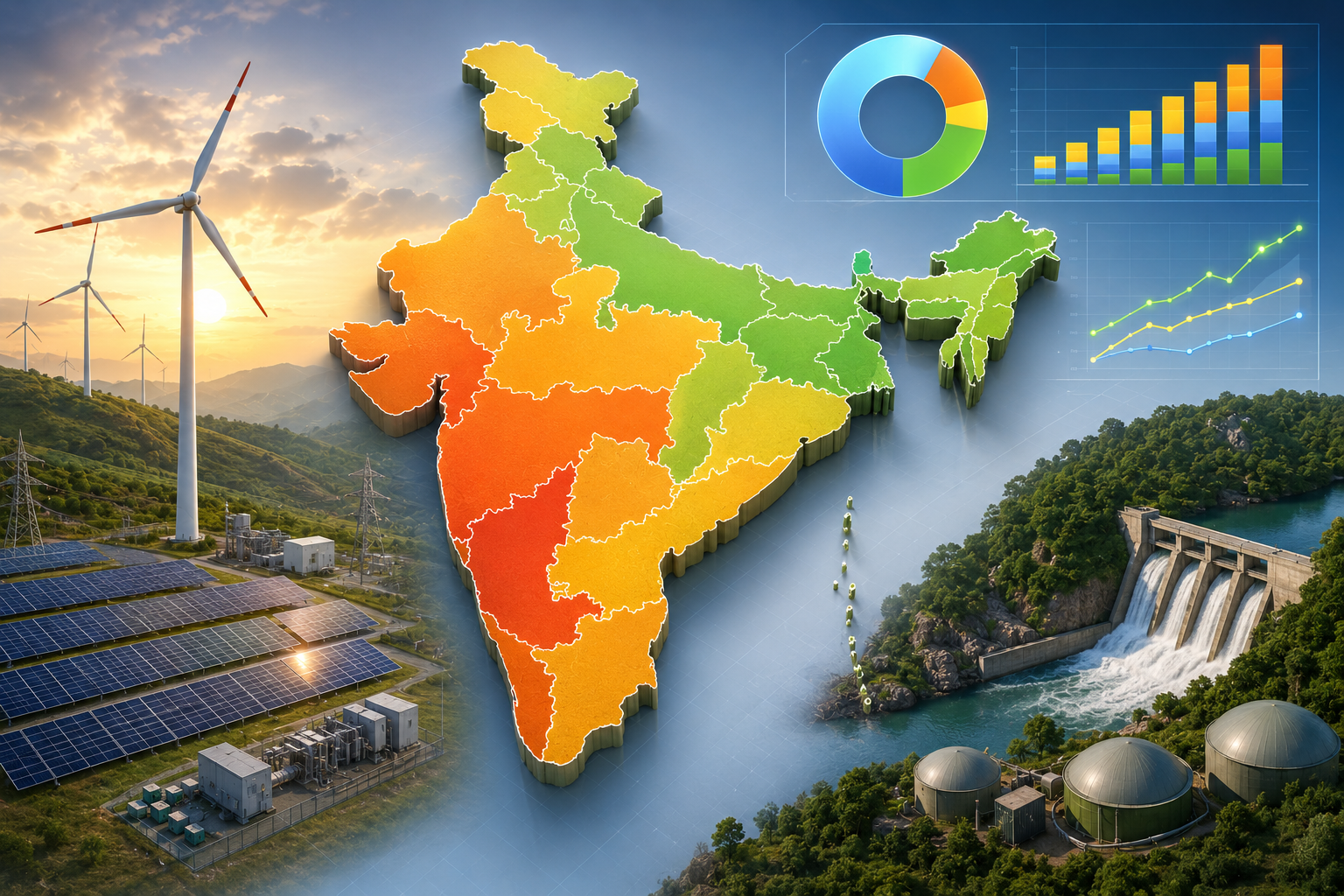
India’s renewable energy sector has achieved remarkable growth, reaching a cumulative installed renewable energy capacity of 279.26 GW as of April 30, 2026. The expansion has been primarily driven by large-scale solar deployment, rapid wind energy development, increasing hydropower utilization, and steady growth in biomass-based generation. Solar power remains the dominant contributor, accounting for 154.24 GW, representing more than half of the country's renewable portfolio. Wind energy follows with 56.44 GW, while large hydro contributes 51.66 GW.
The renewable energy market continues to be concentrated in a few leading states. Gujarat, Rajasthan, Maharashtra, Tamil Nadu, Karnataka, and Andhra Pradesh collectively account for a substantial share of India's installed renewable energy capacity. These states benefit from favorable resource availability, strong transmission infrastructure, proactive policy frameworks, and large-scale private sector investments.
The increasing integration of hybrid renewable projects, rooftop solar installations, distributed generation systems, and emerging energy storage technologies is transforming India's power sector. The country's progress toward achieving its clean energy targets is expected to accelerate further through grid modernization, green hydrogen initiatives, battery storage deployment, and transmission infrastructure expansion.
Key Takeaways
- India's renewable energy capacity reached 279.26 GW by April 2026.
- Solar power dominates with 154.24 GW, accounting for over 55% of total renewable capacity.
- Gujarat leads overall renewable installations with 49.1 GW.
- Rajasthan is India's largest solar state with 41.7 GW.
- Tamil Nadu and Gujarat remain the country's wind energy leaders.
- Maharashtra leads biomass and bioenergy deployment.
- Hydropower remains concentrated in Himalayan and northeastern states.
- Hybrid renewable projects are accelerating across western and southern India.
- Energy storage and transmission expansion will become critical growth enablers.
- India's renewable transition is increasingly driven by a handful of high-performing states that continue to attract the majority of investments and project development.
Why Has Renewable Energy Become a Strategic Priority for India?
India's growing electricity demand, industrial expansion, urbanization, and climate commitments have made renewable energy development a national priority. Renewable energy offers multiple benefits:
- Reduces dependence on imported fossil fuels.
- Improves long-term energy security.
- Supports India's net-zero ambitions.
- Attracts domestic and foreign investments.
- Generates employment opportunities.
- Strengthens rural economic development.
- Enhances grid resilience and sustainability.
The rapid increase in solar and wind deployment demonstrates India's commitment to building a cleaner and more diversified energy mix.
Which Renewable Energy Technologies Are Driving India's Growth?
Technology-wise Installed Capacity (April 2026)
Key Observation
Solar energy has emerged as the dominant renewable technology, contributing over half of India's renewable capacity. The falling cost of solar modules, large-scale solar parks, rooftop adoption, and government incentive programs have accelerated deployment across multiple states.
Which States Lead India’s Renewable Energy Capacity Rankings?
Top 10 Renewable Energy States (Installed Capacity in MW)
Market Insight
The Top Tier Duopoly (Gujarat & Rajasthan)
- Close Contest: Gujarat (49,115.60 MW) and Rajasthan (47,754.45 MW) heavily dominate India's clean energy landscape.
- Combined Power: Together, these two states account for 96,870.05 MW, representing roughly 39.8% of the total capacity of the top 10 states combined.
The Industrial Core (Maharashtra, Tamil Nadu, Karnataka)
- Mid-Tier Clusters: Maharashtra, Tamil Nadu, and Karnataka form a stable second tier, each holding between 26,000 MW and 33,000 MW.
- Regional Engine: Southern dominance is highly apparent here, with Tamil Nadu and Karnataka together anchoring over 56,000 MW of capacity.
The Growth Gap
- Sharp Dropoff: There is a significant drop in capacity after the 5th rank (Karnataka). 6th-ranked Andhra Pradesh (16,178.03 MW) holds roughly 10,000 MW less capacity than Karnataka.
- Bottom Concentration: The lower half of the top 10 list (ranks 6 through 10) collectively contributes 56,332.50 MW—which is only slightly higher than Gujarat's solo capacity.
How is Solar Power Reshaping the Renewable Energy Market?
Solar energy has become India's fastest-growing renewable energy segment.
Leading Solar States Capacity (MW)
Why is Rajasthan Leading Solar Development?
Rajasthan possesses:
- Exceptional solar irradiation levels.
- Vast tracts of available land.
- Dedicated solar parks.
- Strong interstate transmission connectivity.
- Large utility-scale project pipeline.
The state alone contributes more than 41 GW of installed solar capacity, making it India's largest solar market.
Why is Gujarat Emerging as a Solar Superpower?
Gujarat has leveraged:
- Hybrid renewable policies.
- Industrial demand growth.
- Solar manufacturing ecosystem.
- Transmission infrastructure expansion.
- Large-scale renewable energy parks.
Its installed solar capacity exceeds 31 GW, placing it second nationally.
Which States Dominate Wind Energy Development?
India's wind market remains concentrated in resource-rich coastal and southern states.
Top Wind Energy States
Top Tier Dominance
- Leader: Gujarat leads the nation with 15,782 MW of wind capacity.
- Runner-Up: Tamil Nadu holds the second spot with 12,159 MW.
- Major Share: Together, these two states account for 54.2% of the total wind capacity listed.
Steeper Capacity Drop-offs
- Mid-Tier: Karnataka and Maharashtra follow with 8,744 MW and 6,041 MW respectively.
- Lowest Tier: Rajasthan (5,410 MW) and Andhra Pradesh (4,416 MW) sit at the bottom of this top list.
- The Gap: Gujarat's single capacity is over 3.5 times larger than that of Andhra Pradesh.
Growth Drivers
- Strong wind corridors.
- Competitive bidding mechanisms.
- Hybrid project opportunities.
- Repowering of old wind assets.
- Growing corporate renewable procurement.
The combined contribution of Gujarat and Tamil Nadu accounts for nearly half of India's installed wind capacity.
How Important is Biomass and Waste-to-Energy Capacity Across States?
Bioenergy continues to support renewable diversification and rural economic development.
Leading Bioenergy States (Capacity in MW)
Key Data Insights:
Absolute Leader
- Maharashtra Dominates: Leads the nation with 3,000 MW of bioenergy capacity.
- Outsized Impact: This single state accounts for nearly 40% of the total capacity (7,522 MW) combined across all six listed states.
Sharp Step-Downs
- The 1k Club: Only Karnataka (1,917 MW) and Tamil Nadu (1,055 MW) join Maharashtra in crossing the 1,000 MW threshold.
- The Scale Gap: Maharashtra’s capacity is over 8.5 times larger than that of the lowest-ranked state, West Bengal (352 MW).
Regional Strongholds
- Southern Concentration: The southern cluster (Karnataka, Tamil Nadu, and Andhra Pradesh) collectively commands 3,587 MW, showcasing a massive regional bioenergy hub driven by agro-industries like sugar manufacturing
Key Trends
- Expansion of bagasse cogeneration in sugar-producing regions.
- Increased utilization of agricultural residues.
- Rising waste-to-energy projects in urban centers.
- Support for circular economy initiatives.
States with strong agricultural economies continue to dominate biomass deployment.
Which States are Leveraging Hydropower Most Effectively?
Hydropower remains a critical source of renewable generation and grid balancing.
Leading Large Hydro States (Capacity in MW)
Key Data Insights:
Mountainous Region Dominance
- Himachal Pradesh Leads: Commands a massive 11,421 MW of large hydro capacity.
- Himalayan Outsized Share: It accounts for nearly 45% of the total capacity among the listed states (25,502 MW).
- Top Two States: Combined with Uttarakhand (5,035 MW), the top two Himalayan states control roughly 64.5% of the list's total capacity.
Severe Capacity Drop-off
- The Scale Gap: Himachal Pradesh's capacity is more than 5 times larger than that of the lowest-ranked state, Odisha (2,155 MW).
- Flat Bottom Tier: The bottom four states (Telangana, Tamil Nadu, Sikkim, Odisha) are closely clustered together, each hovering tightly between 2,100 MW and 2,500 MW.
Strategic Importance
Hydropower:
- Provides flexible generation.
- Supports peak demand management.
- Balances intermittent solar and wind generation.
- Enhances grid stability.
Mountainous states continue to dominate India's hydropower portfolio.
How Are Hybrid Renewable Projects Transforming State Energy Portfolios?
Hybrid renewable projects combine solar, wind, and storage technologies to improve reliability and utilization of transmission infrastructure.
Leading Hybrid Capacity States (Capacity in MW)
Benefits
- Higher capacity utilization factors.
- Improved power supply reliability.
- Reduced intermittency challenges.
- Better transmission asset utilization.
- Enhanced integration of battery storage systems.
What Are the Key Growth Drivers Behind Leading States?
Gujarat
- Largest overall renewable portfolio.
- Strong solar and wind resource base.
- Industrial demand growth.
- Renewable manufacturing ecosystem.
- Dedicated renewable energy parks.
Rajasthan
- Highest solar capacity nationally.
- Large land availability.
- Excellent solar irradiation.
- Interstate power export capability.
Maharashtra
- Diversified renewable mix.
- Strong biomass sector.
- Rapid solar expansion.
- Large electricity demand center.
Tamil Nadu
- Mature wind energy market.
- Expanding solar capacity.
- Industrial consumption growth.
- Advanced renewable integration.
Karnataka
- Balanced solar-wind portfolio.
- Significant bioenergy contribution.
- Favorable renewable investment climate.
What Challenges Could Impact Future Renewable Expansion?
Despite impressive growth, several challenges remain:
- Grid Integration: Rapid renewable additions require transmission strengthening and balancing resources.
- Land Acquisition: Utility-scale projects continue to face land procurement challenges.
- Curtailment Risks: Some renewable-rich regions experience grid congestion during peak generation periods.
- Energy Storage Requirements: Growing solar and wind penetration increases the need for battery and pumped hydro storage.
- Financial Health of DISCOMs: Distribution company finances continue to influence renewable procurement growth.
What Does the Future Hold for India’s Renewable Energy Market?
India is entering the next phase of renewable energy development characterized by:
- Utility-scale solar expansion.
- Offshore and high-capacity wind deployment.
- Large battery energy storage systems (BESS).
- Green hydrogen production hubs.
- Renewable energy manufacturing growth.
- Smart grid modernization.
- Interstate transmission corridor development.
Leading states such as Gujarat, Rajasthan, Maharashtra, Tamil Nadu, Karnataka, Andhra Pradesh, and Madhya Pradesh are expected to remain at the forefront of renewable investments through 2030 and beyond.
Outlook:
India’s renewable energy sector is poised for robust growth, driven by ambitious clean energy targets, rising electricity demand, and accelerating investments in solar, wind, hybrid, and energy storage projects. States such as Gujarat, Rajasthan, Maharashtra, Tamil Nadu, and Karnataka are expected to remain key growth engines due to their strong resource potential and supportive policies. The next phase of expansion will increasingly focus on Battery Energy Storage Systems (BESS), green hydrogen production, rooftop solar adoption, and transmission infrastructure upgrades. With continued policy support and private-sector participation, India is well positioned to strengthen energy security while advancing its decarbonization goals.