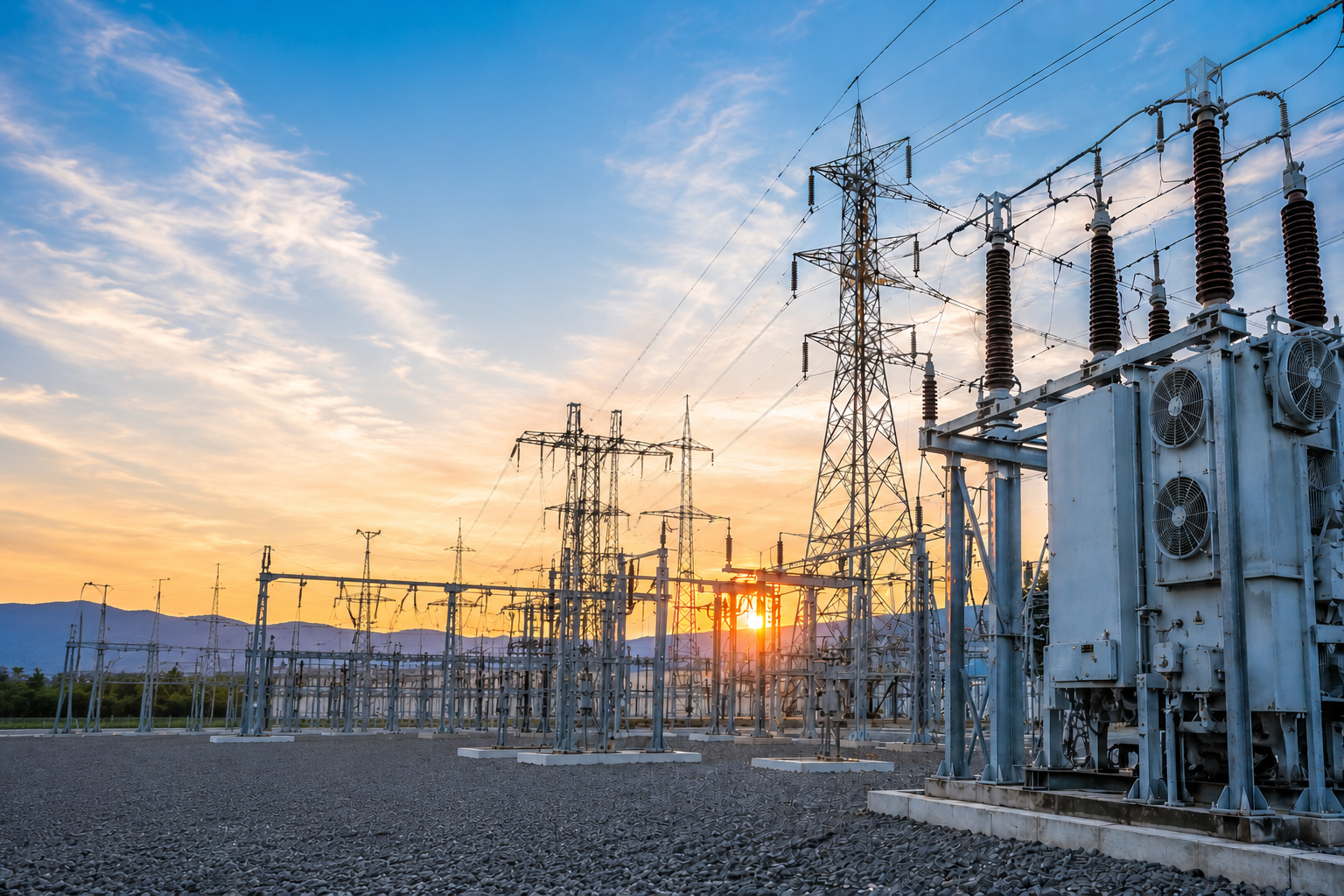
In March 2026, India continued an impressive leap in expanding its transmission infrastructure with 21,605 MVA of new substation capacity installed or planned for commissioning in the central, state, and private sectors. Much of the new capacity was driven by the need to enable renewable energy, strengthen interstate transmission, and meet urban load demand in major industrial and demand centers.
Most of the capacity additions occurred in the central sector from large transformer augmentation works by Power Grid Corporation of India Limited (PGCIL). Torn between regional reliability and the need to contain demand and enable renewable energy, state transmission utilities also invested heavily in 220 kV and 400 kV substation projects in the period.
During the month, a notable trend was the concentration of high voltage infrastructure in the renewable energy abundant states of Rajasthan, Gujarat, Andhra Pradesh, and Karnataka. This represents the trend towards a renewable energy power system dominated by a modernized grid in India.
Key Takeaways
- During March 2026, total commissioned and ready-for-commissioning substation capacity additions reached 21,605 MVA.
- The Central Sector accounted for nearly 58% of total additions, driven primarily by interstate renewable evacuation projects.
- Increasing long-distance transmission needs were reflected by major increases in 765/400 kV and 400/220 kV levels.
- Renewable energy-linked transmission infrastructure continued to dominate investment activity, especially in Rajasthan and Gujarat RE zones.
Intra-state transmission infrastructure was upgraded by state utilities like GETCO, MSETCL, APTRANSCO, and UPPTCL to reinforce the grid, especially to address the emerging demand from industry.
Which Sector Drove India’s Substation Capacity Additions in March 2026?
The central sector became the main force in India’s transmission expansion for the month of March 2026, with a total of 12,500 MVA, representing almost 58% of the total capacity added for that month. PGCIL’s evacuation projects primarily in Rajasthan and Gujarat were among the first to integrate renewable energy and thus contributed significantly to the central sector dominance. The state sector contributed 7,605 MVA, which continued the region’s investment in urban load management and strengthening regional transmission. The private sector contributed 1,500 MVA and marked the growing role of private transmission companies and renewable energy developers in the expansion of the grid.
Which Voltage Levels Saw the Highest Capacity Expansion?
The highest additions were observed in the 765/400 kV and 400/220 kV voltage classes, highlighting India’s continued focus on strengthening high-capacity interstate transmission infrastructure. The 765/400 kV segment alone accounted for approximately 7,500 MVA of additions while 400/220kV for 8875 MVA, reflecting increasing power transfer requirements from renewable-rich regions to demand centers. Simultaneously, the 400/220 kV network expansion supports regional load balancing and grid stability. Lower voltage additions, particularly in the 220 kV category, indicate steady growth in intra-state transmission infrastructure and urban substations.
Which State Utilities Led Transmission Infrastructure Expansion?
In terms of utilities in different states, GETCO was found to be the largest player for capacity addition in the country in October, owing to several 220 kV and 400 kV augmentation projects. MSETCL was also found to contribute considerably towards additions, thanks to its efforts towards GIS and urban substation augmentation. Utilities from Andhra Pradesh, Uttar Pradesh, Odisha, and Telangana were involved in building regional networks to facilitate industrial development and renewable power deployment.
How Significant Was Renewable Energy in Driving Transmission Investments?
Many of the newly added capacities at the substations were directly connected to the facilities used for renewable energy evacuation. About 63% of the entire new commissioning capacity was related to renewable energy zones, solar parks, and green energy corridors. Rajasthan emerged as the leader in the area of renewable energy transmission projects, especially through its Bhadla and Fatehgarh transmission projects. There were also many significant developments of renewables in the Gujarat and Karnataka regions.
Conclusion
March 2026 substation capacity increases reaffirm India’s aggressive approach to its grid growth, with particular focus on incorporation of renewable power and improvement in inter-state power transmission capabilities. Prevalence of high voltage capacity construction projects indicates shifting needs due to rapid evolution of the power grid. In future, continued efforts in areas of grid flexibility, transformer upgrades, and renewable evacuation will be essential for India’s expanding energy needs.