Executive Summary
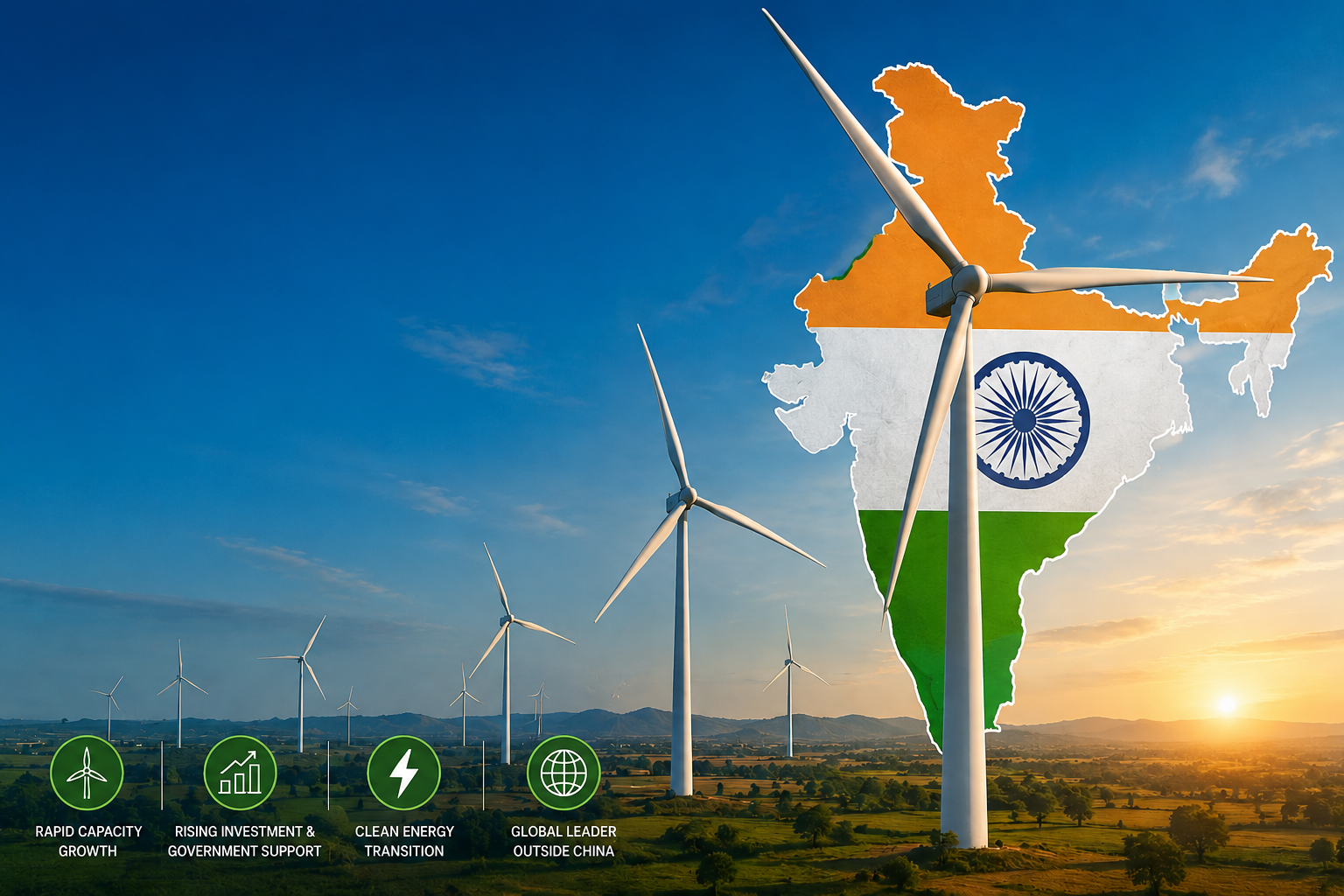
India became the world’s largest wind market outside China in 2025 after adding a record 6.3 GW of wind capacity. The achievement reflects rapid growth in renewable energy investments, policy support, and domestic manufacturing expansion.
Key Takeaways
- India added 6.3 GW of wind capacity in 2025.
- The country overtook the US and Germany in annual installations.
- Hybrid renewable energy auctions accelerated deployment.
- Domestic manufacturers strengthened market presence.
- India may add nearly 30 GW by 2030.
How Fast Was India’s Wind Sector Growing?
India’s annual wind additions accelerated significantly between 2021 and 2025. The visible data labels highlight how installations nearly doubled in 2025. India’s rise in the wind sector was driven by government-backed clean energy auctions, strong private sector participation, and delayed projects from 2024 being commissioned in 2025. The growth of renewable energy parks such as Khavda in Gujarat significantly accelerated capacity additions.
How Is India’s Expanding Wind Market Strengthening Its Energy Security and Industrial Competitiveness?
India has become the world’s second-largest wind market after China as of 2025. This rise shows the country’s growing role in the global shift toward renewable energy. China still leads with nearly 80 GW of annual wind capacity additions. However, India outpaced major developed countries like the United States (5.2 GW), Germany (4.1 GW), and Brazil (3.8 GW) by adding a record 6.3 GW of wind capacity last year. This progress reflects the fast growth of India’s clean energy sector and its efforts to improve energy security by cutting reliance on imported fossil fuels. Wind energy plays a key role in India’s goal of reaching 500 GW of non-fossil fuel energy capacity by 2030 and in meeting its long-term climate goals. At the same time, the wind sector is driving changes in industry. Companies like Suzlon, Inox Wind, and Adani Wind are quickly expanding their manufacturing abilities to meet increasing domestic demand. The rise in local turbine manufacturing is helping India create a stronger renewable energy supply chain, lower import dependence, generate jobs, and establish itself as a growing global center for clean energy manufacturing and technology.
What Challenges Could Slow Future Growth?
Transmission infrastructure constraints, land acquisition challenges, financing issues, and policy uncertainty remain important obstacles. Grid modernization will be essential to support future wind capacity additions.
What Opportunities Does the Wind Sector Create?
The wind sector can generate large-scale employment, support green hydrogen production, and promote industrial decarbonization. India is also exploring offshore wind projects along the Gujarat and Tamil Nadu coasts.
India’s future leadership will depend on improving transmission networks, scaling offshore wind, and strengthening domestic manufacturing competitiveness in the face of growing Chinese competition.
Conclusion
India’s emergence as the largest wind market outside China represents a major shift in the global renewable energy landscape. The country’s progress reflects strong policy direction, rising industrial capability, and growing investor confidence in clean energy.
Sustaining this momentum will require continued investments in transmission infrastructure, manufacturing localization, and technological innovation. If these challenges are addressed successfully, India could become one of the world’s leading renewable energy powers over the coming decade.