Executive Summary
India’s transmission sector recorded robust growth in FY 2025–26, led by large-scale renewable energy evacuation projects and strategic grid strengthening across the Inter-State Transmission System (ISTS) and state networks. The year was marked by substantial commissioning of 765 kV and 400 kV transmission corridors connecting renewable hubs such as Khavda in Gujarat and Bhadla in Rajasthan to major demand centres. Power Grid Corporation of India Limited remained the dominant developer, executing most high-voltage ISTS projects, including over 2,300 ckm of 765 kV lines. Key projects such as Bhadla II–Sikar II (628 ckm), Ahmedabad–Navsari (590 ckm), and Fatehgarh–Bhadla III (635 ckm) significantly enhanced the country’s capacity to integrate more than 20 GW of renewable energy.
Private sector participation continued to expand through tariff-based competitive bidding, with Adani Energy Solutions Limited, Tata Power Company Limited, Sterlite Power Transmission Limited (Resonia), ReNew Power Private Limited, and others strengthening their market presence. At the state level, rapid expansion of 220 kV networks supported industrial zones, urban load centres, and solar parks across Uttar Pradesh, Gujarat, Haryana, Maharashtra, and Tamil Nadu. Increasing use of LILO configurations, GIS substations, and underground cabling reflects a broader shift toward flexible, efficient, and technology-driven network development. The sector outlook remains highly positive, supported by annual renewable integration requirements of around 25 GW and continued expansion of 765 kV and HVDC corridors.
Key Takeaways
- FY 2025–26 saw strong transmission growth, driven primarily by renewable energy evacuation from Khavda, Bhadla, and other Renewable Energy Zones (REZs).
- Power Grid Corporation of India Limited remained the dominant transmission developer, leading most 765 kV and major 400 kV ISTS projects.
- More than 2,300 ckm of 765 kV transmission lines were commissioned, significantly strengthening India’s high-capacity national grid backbone.
- Rajasthan and Gujarat emerged as the most active transmission markets due to large-scale solar and wind development.
- Private developers such as Adani Energy Solutions Limited, Tata Power Company Limited, Sterlite Power Transmission Limited (Resonia), and ReNew Power Private Limited expanded their presence through tariff-based competitive bidding (TBCB).
- The 400 kV segment showed the highest diversity of participants, supporting both renewable integration and conventional generation evacuation.
- State utilities accelerated 220 kV network expansion to connect industrial corridors, urban load centres, and solar parks.
- LILO configurations, GIS substations, and underground cabling gained wider adoption to improve system flexibility and land-use efficiency.
- The long-term outlook remains strong, supported by annual renewable integration needs of around 25 GW and continued expansion of 765 kV and HVDC corridors.
Key Questions for the India Transmission Market (FY 2025–26)
- Which renewable energy corridors and states drove the highest transmission line commissioning in FY 2025–26?
- How did PGCIL maintain its dominant role in India’s 765 kV and 400 kV transmission expansion?
- What impact did private developers such as Adani Energy, Tata Power, and Sterlite Power Transmission have on the competitive transmission market?
- How will continued 765 kV and HVDC expansion support India’s target of integrating approximately 25 GW of renewable energy each year?
Key market trends:
- Dominance ofrenewable energy evacuation projects (Khavda, Bhadla, Rajasthan REZ)
- Strong participation from central utility >Power Grid Corporation of India Limited
- Growing private participation via TBCB routes (Tata Power, Adani, Sterlite/Resonia, Torrent)
- Rapid expansion of intra-state 220 kV networks supporting load centres and industrial demand
- Increasing use of LILO configurations for system optimization and substation integration
Data Insights
- Longest Project: Bhadla II–Sikar II covers the highest distance at 628 cKm.
- Shortest Project: KPS2–KPS3 (both Ckt-1 and Ckt-2) represents the shortest addition at 15 cKm.
- Executing Agency: Every asset listed in this transmission table is managed entirely by the Power Grid Corporation of India Limited.
Market Insight (765 kV Segment):
- Strong clustering in Rajasthan–Gujarat REZ corridors
- Backbone development for >20 GW renewable evacuation
- Entire segment led by Power Grid Corporation of India Limited under SPV structure
Market Insight (400 kV Segment):
- Highly diversified developer participation
- Strong inter-state reinforcement in ER–WR–NR corridors
- Private sector gaining share through TBCB bidding
- Critical role of renewable integration + thermal evacuation hybridization
Data Insights
- Longest Project: Fatehgarh–Bhadla-III executed by Sterlite Power Transmission Limited is the longest asset at 635 cKm.
- Shortest Project: Agra–Jaipur LILO* (Dausa) managed by Power Grid Corporation of India Limited spans the shortest distance at 44 cKm.
- Leading Agency: Power Grid Corporation of India Limited operates the absolute majority of projects listed in this segment (6 out of 10)
Market Insight (220 kV Segment):
- Strong intra-state grid strengthening across UP, Gujarat, Maharashtra, and Karnataka
- Rapid industrial load connectivity (IMT Kharkhoda, solar parks)
- High share of LILO-based network optimization
- Increasing underground cable adoption in urban clusters
Data Insights
- Longest Project Pool: Various UP/MP/Rajasthan Lines represent the largest aggregate additions, estimated at ~300+ cKm.
- Shortest Project: Shivajinagar–Ampyr Solar managed by MSETCL is the shortest segment with only 11 cKm.
- Sector Distribution: The State sector dominates this specific voltage category, controlling 7 out of the 10 listed items.
Key Market Observations & Sector Outlook
Strong Renewable-Driven Transmission Growth
The FY 2025–26 commissioning pipeline is heavily concentrated in renewable-rich states:
- Rajasthan (Bhadla, Fatehgarh, Sikar corridors)
- Gujarat (Khavda complex expansion)
- Karnataka & Andhra Pradesh solar zones
Dominance of Central Transmission Utility
Power Grid Corporation of India Limited continues to dominate ISTS execution through SPV-based projects, ensuring:
- Faster execution timelines
- Standardized corridor development
- Improved inter-state reliability
Rise of Private Transmission Developers
Key players expanding footprint:
- Adani Energy Solutions Limited
- Tata Power Company Limited
- Resonia (Sterlite Power Transmission Limited)
- Torrent Power Limited
- L&T
- KEC International
- Kalpataru Power
Technology & Design Trends
- Higher adoption of 765 kV backbone corridors
- Increased use of LILO configurations
- Expansion of GIS substations in urban load centres
- Underground cabling in metro distribution networks
Outlook
The transmission sector is expected to continue strong growth with 25 GW renewable integration requirement annually
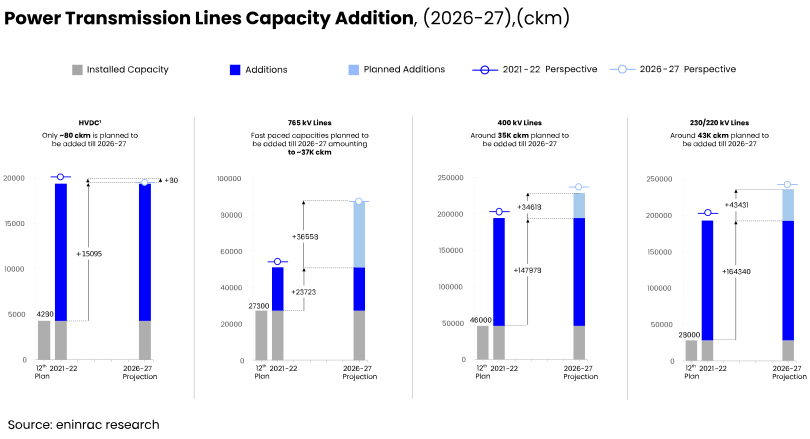
Strategic Transmission Grid Outlook (Target: 2026-27)
India's power transmission grid in circuit kilometers (ckm) from the 12th Plan/2021-22 up to the 2026-27 projections, categorized by voltage levels:
- HVDC: Minimal growth is planned, with only approximately 80 ckm projected to be added by 2026-27, maintaining a level just above 19,000 ckm.
- 765 kV Lines: Fast-paced expansion is projected. Capacity is set to increase by roughly 37K ckm, rising sharply from around 51,000 ckm in 2021-22 to nearly 88,000 ckm.
- 400 kV Lines: This category represents the largest overall volume. Grid capacity is projected to expand by around 35K ckm (specifically +34,618 ckm), pushing total capacity past 230,000 ckm.
- 230/220 kV Lines: Significant expansion is expected here, with an additional 43K ckm (specifically +43,431 ckm) projected to be built, bringing the total close to 240,000 ckm.
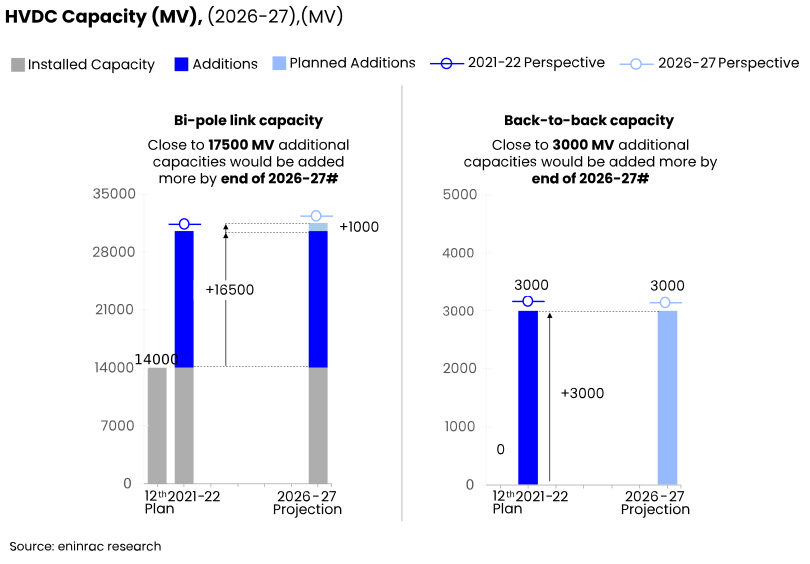
HVDC Capacity Outlook (Target: 2026-27)
- Bi-pole Link Capacity: This segment dominates the planned HVDC additions, with close to 17,500 MW (specifically +16,500 MW and +1,000 MW increments) of capacity projected to be added relative to the baseline.
- Back-to-back Capacity: Growth in this segment is entirely complete, with 3,000 MW added between the 12th Plan and 2021-22, holding completely flat through the 2026-27 projection period.
- Strategic Takeaway: While physical HVDC line length expansions remain completely flat (as seen previously), India's power grid strategy focuses heavily on maximizing the power injection capacity of its existing bi-pole systems.