Executive Summary
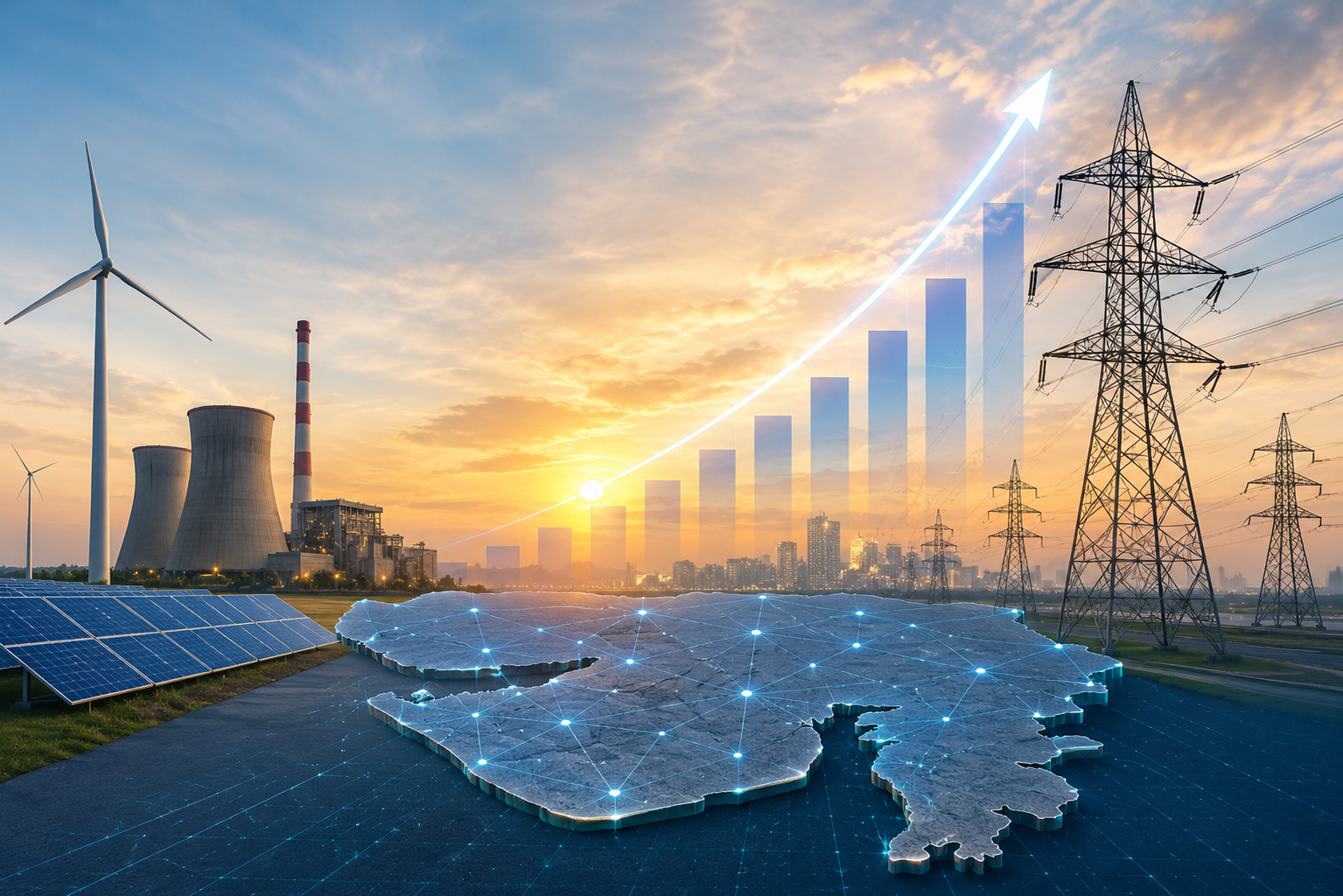
Gujarat has emerged as one of India’s fastest-growing economic centers, supported by rapid industrialization, urban development, agricultural modernization, and leadership in renewable energy. This growth has driven a steady increase in electricity consumption and necessitated significant expansion of the state’s transmission network.
As per the Resource Adequacy Plan prepared by the Central Electricity Authority, Gujarat’s peak electricity demand is projected to rise from 25.6 GW in 2024–25 to approximately 29.9 GW by 2027–28 and 56 GW by 2034–35. Additional demand from Green Hydrogen and Green Ammonia (GHGA) manufacturing is expected to contribute around 32 GW, primarily in the coastal hubs of Mundra and Kandla.
Installed generation capacity in the state stood at 58.2 GW as of March 2025, including 31.4 GW of renewable energy (RE). Total installed capacity is projected to increase to 97 GW by 2026–27 and 183 GW by 2034–35, requiring extensive reinforcement of both the Inter-State Transmission System (ISTS) and Intra-State Transmission System (InSTS).
Key Takeaways
- Gujarat is projected to witness peak electricity demand rising from 25.6 GW in 2024–25 to 56 GW by 2034–35, representing more than a twofold increase.
- Installed generation capacity is expected to grow from 58.2 GW in March 2025 to 97 GW by 2026–27 and 183 GW by 2034–35, driven primarily by renewable energy additions.
- Renewable energy already contributes 31.4 GW, accounting for 54% of total installed capacity, reinforcing Gujarat’s leadership in solar and wind development.
- Green Hydrogen and Green Ammonia projects at Mundra and Kandla are expected to create an additional 32 GW of electricity demand by 2034.
- By 2026–27, Gujarat plans to add 7,279 ckm of ISTS lines and 5,615 ckm of intra-state transmission lines to support near-term demand and renewable integration.
- Between 2027–28 and 2034–35, major investments in HVDC, 765 kV, 400 kV, and 220 kV infrastructure will significantly strengthen the transmission network and ensure reliable power supply across the state.
Key Questions for Analysis
- How will Gujarat meet the projected increase in peak electricity demand from 25.6 GW in 2024–25 to 56 GW by 2034–35?
- What transmission infrastructure additions are planned by 2026–27 and 2034–35 to integrate renewable energy and maintain grid reliability?
- How much additional electricity demand will be created by Green Hydrogen and Green Ammonia projects at Mundra and Kandla?
- What role will HVDC and 765 kV transmission systems play in evacuating renewable power from Kachchh and Saurashtra to major load centers?
- How will Gujarat’s growing renewable energy capacity and industrial expansion influence long-term investment requirements in the state transmission network?
Gujarat Power Sector Snapshot (FY 2024–25)
Market Insights: Installed Generation Capacity in Gujarat (as on 31 March 2025)
- Gujarat has a total installed generation capacity of 58,221 MW, making it one of India’s largest and most diversified power markets.
- Renewable Energy dominates the generation mix, accounting for 31,403 MW (54%) of total capacity, highlighting Gujarat’s leadership in solar and wind energy development.
- Coal and lignite remain the second-largest source with 16,092 MW (27.6%), providing critical baseload power to support industrial and commercial demand.
- Gas-based generation contributes 6,896 MW (11.8%), offering flexible and peaking support, which is particularly valuable for balancing intermittent renewable energy.
- Low-carbon firm power sources, including hydro (1,990 MW) and nuclear (1,840 MW), together account for 6.6% of installed capacity and enhance grid stability.
- Gujarat’s generation portfolio indicates a strategic transition toward clean energy while maintaining sufficient conventional capacity to ensure reliability.
- With more than half of installed capacity from renewables, Gujarat is well positioned to support large-scale industrial electrification and future Green Hydrogen and Green Ammonia projects.
- The strong renewable base will drive significant investments in transmission, storage, and balancing infrastructure over the next decade.
Key Highlights
- Renewable energy accounts for more than half of Gujarat’s installed capacity.
- Gujarat is among India’s leading states in utility-scale solar and wind development.
- The state has a diversified generation mix that supports both baseload and clean energy growth.
Peak Electricity Demand Forecast
Market Insights: Peak Electricity Demand Forecast in Gujarat
- Gujarat’s peak electricity demand is projected to increase from 25,588 MW in 2024–25 to 56,000 MW by 2034–35, reflecting a substantial 119% growth over the next decade.
- Demand growth remains moderate in the near term, reaching 29,900 MW by 2027–28, indicating a steady expansion in industrial, commercial, and agricultural consumption.
- A sharp acceleration is expected after 2027–28, with peak demand rising to 40,000 MW by 2030–31, driven by large-scale renewable integration, industrial expansion, and electrification.
- The addition of Green Hydrogen and Green Ammonia projects, particularly at coastal hubs such as Mundra and Kandla, will significantly increase electricity requirements and create new high-load centers.
- The projected doubling of demand underscores the need for major investments in generation, transmission, energy storage, and grid balancing infrastructure.
- Utilities, transmission developers, and equipment suppliers are likely to benefit from sustained capital expenditure as Gujarat strengthens its power system to support long-term economic and clean energy growth.
Demand Drivers
- Expansion in petrochemicals, engineering, textiles, and manufacturing.
- Increased residential and commercial consumption.
- Daytime agricultural load due to feeder segregation.
- Large-scale green hydrogen and ammonia production.
Installed Capacity Outlook
Note: The state will add nearly 125 GW of generation capacity over ten years, most of it from solar and wind projects in Kachchh, Saurashtra, and northern Gujarat.
Transmission Expansion Planned up to 2026–27
Market Insights: Transmission Expansion Planned up to 2026–27
- Gujarat plans to add 86,000 MVA of Inter-State Transmission System (ISTS) capacity and 27,355 MVA of intra-state capacity by 2026–27, indicating substantial investment to support rising electricity demand and renewable integration.
- The 765 kV network will form the backbone of the expansion, accounting for 72,000 MVA and 6,351 ckm of ISTS lines, enabling bulk transfer of power from renewable-rich regions such as Kachchh and Saurashtra.
- The 400 kV system will play a critical bridging role, with a combined 24,685 MVA of transformation capacity and 3,206 ckm of lines across ISTS and intra-state networks.
- At the distribution interface, 220 kV infrastructure contributes 16,670 MVA and 3,337 ckm, strengthening power delivery to industrial clusters, urban centers, and agricultural load pockets.
- Overall, the addition of 12,894 ckm of transmission lines and more than 113,000 MVA of transformation capacity underscores Gujarat’s aggressive grid expansion strategy to meet projected demand growth and future Green Hydrogen development.
Outlook for 2026–27
The planned system is designed to:
- Meet peak demand above 28 GW.
- Integrate large renewable additions.
- Strengthen transfer capability to load centers such as Ahmedabad, Surat, Vadodara, and Rajkot.
Transmission Expansion Planned (2027–28 to 2034–35)
Market Insights: Transmission Expansion Planned for 2027–28 to 2034–35
- Gujarat plans to add 120,520 MW/MVA of ISTS capacity and 108,360 MVA of intra-state capacity, reflecting one of India’s largest long-term transmission expansion programs.
- The introduction of 14,500 MW of HVDC capacity with 5,900 ckm of lines will enable efficient bulk transfer of renewable power and support high-demand coastal industrial hubs.
- The 765 kV transmission backbone will expand by 87,000 MVA and 5,518 ckm, strengthening long-distance power evacuation from renewable energy zones such as Kachchh and Saurashtra.
- At the state level, 400 kV, 220 kV, and 220/132 kV systems will add more than 108,000 MVA and 18,991 ckm of lines to improve supply reliability for cities, industrial corridors, and Green Hydrogen projects.
- In total, Gujarat will add 31,550 ckm of transmission lines, creating a robust grid capable of supporting 56 GW peak demand, 183 GW installed capacity, and substantial Green Hydrogen and Green Ammonia development by 2034–35.
Strategic Significance
This build-out will:
- Support projected demand of 56 GW by 2034–35.
- Enable integration of 183 GW of generation capacity.
- Provide evacuation for renewable energy and GHGA projects.
- Improve system reliability and contingency performance.
Green Hydrogen and Renewable Energy Transmission Requirements
Green Hydrogen Hubs
Major Green Hydrogen / Green Ammonia projects are planned nearby:
- Mundra
- Kandla
Estimated additional electricity requirement: 32 GW by 2034.
Renewable Energy Zones
Key RE growth areas include:
- Kachchh
- Saurashtra
- North Gujarat
These regions will be connected through new 765 kV corridors and HVDC systems to transfer bulk renewable power to demand centers.
Forecast Assessment and Recommendations
Power Demand Outlook
- Peak demand is expected to more than double by 2034–35.
- Industrial and clean-energy demand will be the primary growth drivers.
- Daytime demand will remain dominant due to agricultural and solar-linked load patterns.
Transmission Investment Priorities
- Accelerate 765 kV and HVDC backbone development.
- Strengthen 400 kV and 220 kV urban transmission systems.
- Build dedicated corridors for GHGA manufacturing clusters.
- Expand grid-scale energy storage and reactive power support.
- Enhance digital monitoring and forecasting tools.
Conclusion
Gujarat’s electricity sector is entering a transformative phase, with peak demand projected to increase from 25.6 GW to 56 GW by 2034–35 and installed generation capacity rising to 183 GW. To accommodate this growth, the state will require one of India’s most extensive transmission expansions, including large-scale 765 kV and HVDC systems.
The Resource Adequacy Plan provides a robust roadmap to ensure reliable, efficient, and sustainable power delivery while supporting industrial development, renewable energy integration, and the emerging green hydrogen economy.